What happened
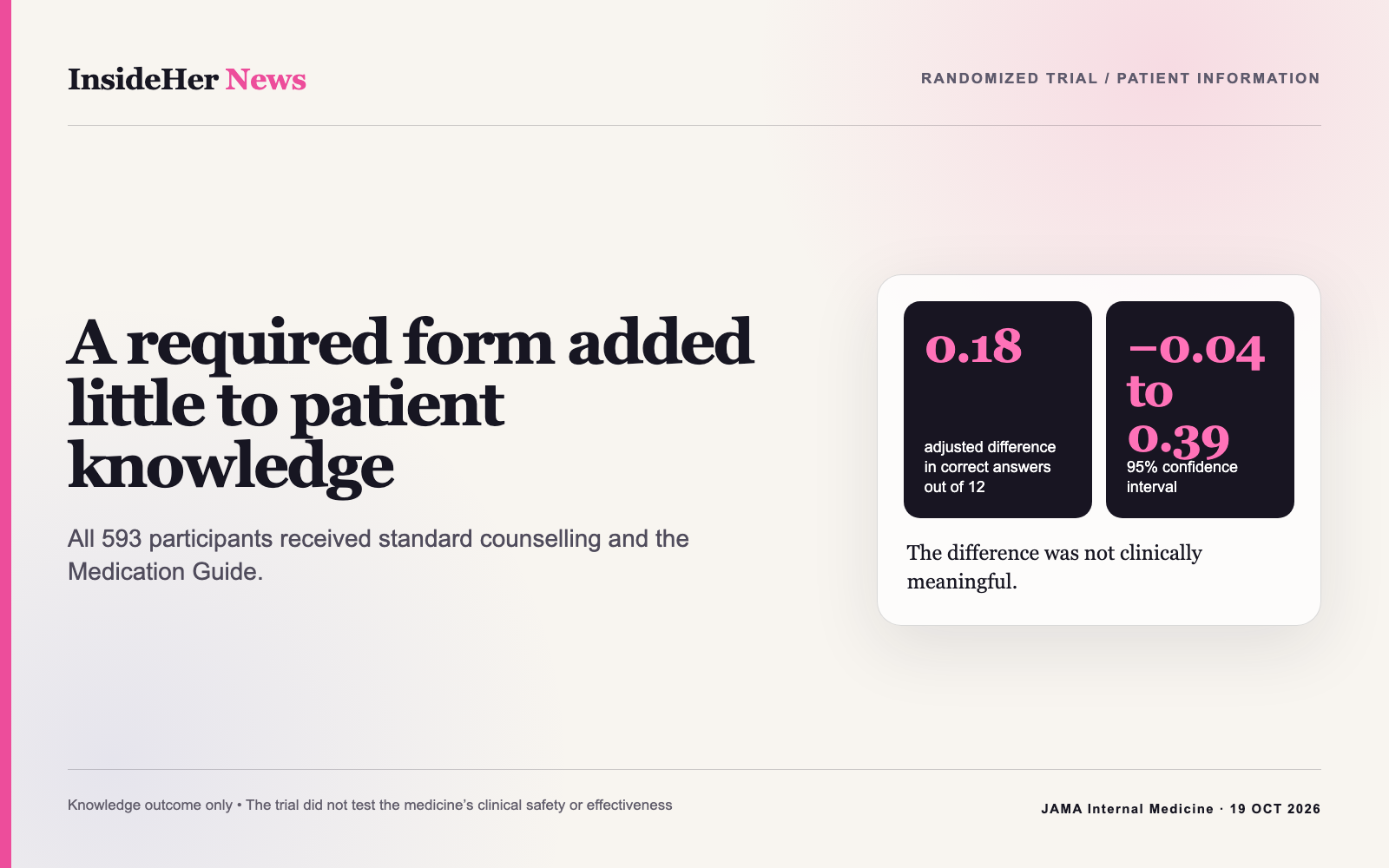
A randomized clinical trial at five US facilities tested whether the mifepristone Patient Agreement Form improves patients’ understanding when it is added to standard counselling and the Medication Guide. Among 593 participants, average knowledge scores were 10.44 out of 12 with the form and 10.26 without it. The adjusted difference was 0.18 points, with a 95% confidence interval from −0.04 to 0.39—below the researchers’ threshold for a clinically meaningful improvement.
The form was tested on top of routine information
Participants seeking medication abortion were randomly assigned either to review and sign the Patient Agreement Form or not to use it. Both groups still received each facility’s standard counselling and the FDA Medication Guide. Researchers then assessed knowledge using 12 questions. This design isolates the incremental value of the form; it does not compare informed care with no counselling.
The trial found high knowledge scores in both groups and no clinically meaningful advantage from the additional form. That result is relevant to a regulatory requirement that adds a step to care, particularly when the stated purpose is to support informed use. It does not mean patient information is unnecessary. It asks whether this particular document adds measurable understanding after other information has already been provided.
What the trial cannot answer
The outcome was short-term knowledge, not adherence, adverse events, access or the clinical safety and effectiveness of mifepristone. The five participating facilities may not represent every setting, language or counselling approach. The study also does not evaluate every component of the FDA’s Risk Evaluation and Mitigation Strategy as a single package.
The authors reported that two investigators had received expert-witness fees from abortion-rights organisations; the paper states that funders had no role in the study’s design, conduct, analysis or publication decisions. In a politically contested area, those disclosures and the trial’s predefined methods both belong in the evidence record.
Why it matters
Consent and risk communication should help patients understand their care without adding steps that do not achieve that goal. A randomized test gives policymakers better evidence than assuming a signed document is necessarily informative. Decisions about regulation still need to consider safety, access, autonomy and the quality of the full counselling process.
What to watch
Replication in more settings and languages, research on patient experience and access, and any FDA response. This study should not be read as personal medical advice or as a reason to skip the information supplied with a prescribed medicine; individual questions belong with a qualified clinician or pharmacist.