What happened
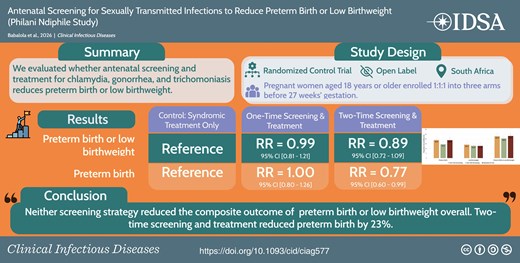
Screening and treating common sexually transmitted infections twice during pregnancy reduced preterm birth in a South African randomized trial. However, it did not significantly improve the primary combined outcome of preterm birth or low birthweight.
What the trial compared
Researchers enrolled 2,247 pregnant women and compared screening once, screening twice, and standard care based on symptoms. Repeat testing occurred at 30–34 weeks. The tests covered chlamydia, gonorrhoea and trichomoniasis.
Among live births, preterm birth occurred in 14.5% of the twice-screened group versus 18.8% with standard care: a 4.3-percentage-point difference. The relative risk was 0.77, with a 95% confidence interval of 0.60–0.99.
Why the primary outcome matters
The combined outcome occurred in 20.6% versus 23.2%, a difference that was not statistically significant. Low birthweight alone also did not improve, and one-time screening did not reduce preterm birth.
The preterm-birth finding was a secondary outcome. It warrants further investigation rather than a claim that the trial definitively establishes a new universal screening schedule. The paper was published on 27 October; Penn Medicine reported it on 29 October.
Why it matters
For InsideHer, the local relevance is substantial: evidence generated in South African antenatal services can inform questions about testing access, repeat infections, treatment and practical implementation.
What to watch
Replication, cost and implementation evidence, treatment completion and how screening could fit local services.