What happened
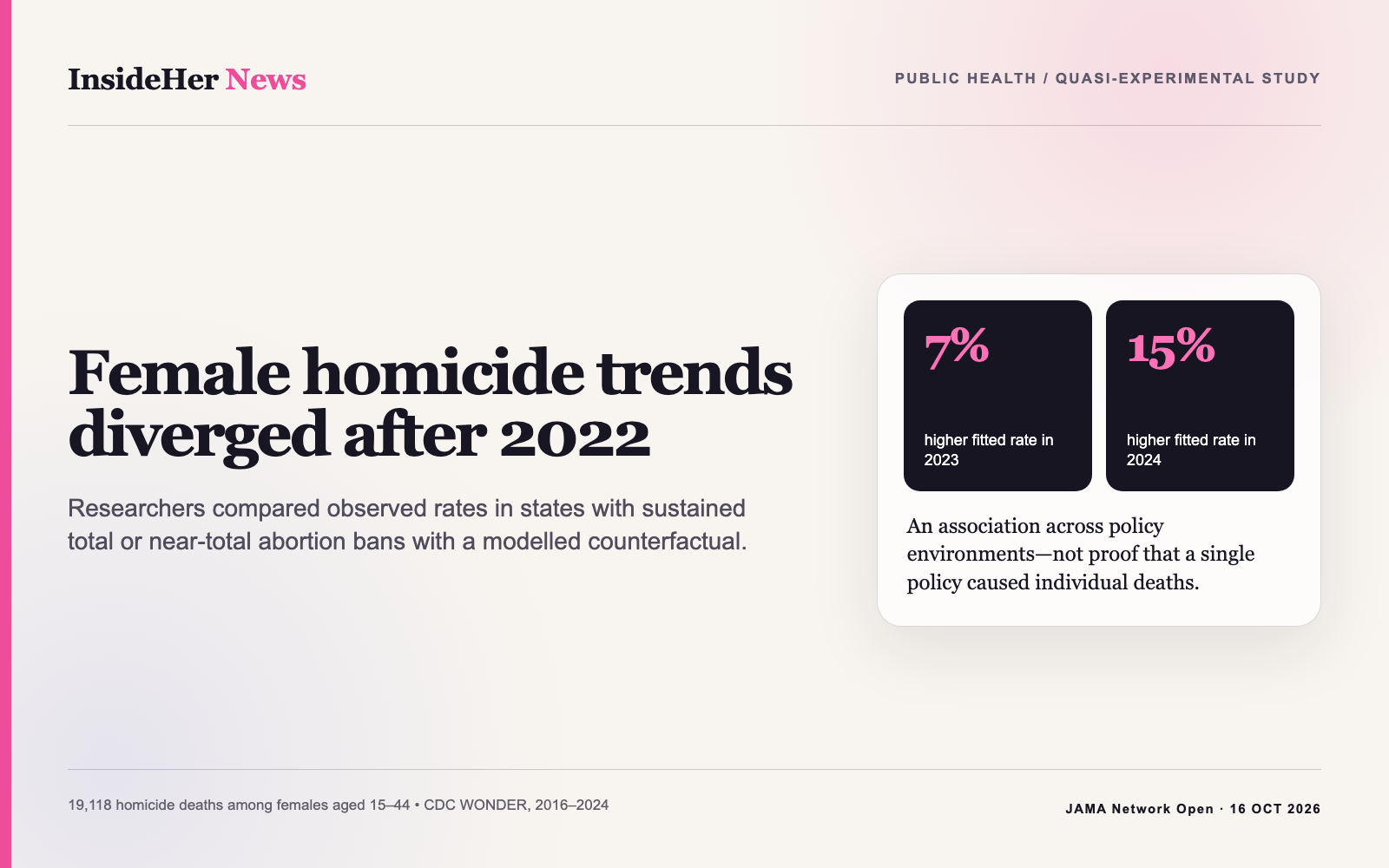
A JAMA Network Open study analysed 19,118 homicide deaths among females aged 15 to 44 in US mortality data from 2016 through 2024. In 11 states with sustained total or near-total abortion bans after the Dobbs decision, the fitted homicide rate was 7% above the study’s modelled counterfactual in 2023 and 15% above it in 2024. The authors estimated 48 excess deaths in 2023 and 87 in 2024, with uncertainty intervals that did not begin at zero.
What the model compared
The researchers used CDC WONDER mortality records and an interrupted time-series approach. They compared observed post-2022 trends in states that maintained total or near-total bans with the rates their model projected from earlier patterns. States with partial or changing restrictions were excluded from the main policy groups, reducing ambiguity but narrowing the result.
Homicide rates differed between policy groups before Dobbs. The analysis accounts for trend and seasonality, but it cannot recreate a randomized comparison between otherwise identical states. Its estimated excess deaths are model-based differences from a counterfactual, not a list of individual deaths that can be assigned to one policy.
Association is not the same as causation
The post-Dobbs change in monthly trend between the sustained-ban and protected groups was statistically significant but close to the threshold reported by the study. Other differences between states, changing social conditions and measurement choices may contribute to the divergence. The study does not establish the mechanism behind any increase, and its results should not be converted into a claim that abortion policy directly caused each death.
The finding nevertheless warrants attention. Violence is a health issue, and reproductive policy can interact with economic security, pregnancy, relationships and access to support. Longer follow-up and studies designed to test those pathways are needed to understand whether, where and how policy environments affect risk.
Why it matters
Deaths from violence are not separate from women’s health. The study raises a serious population-level signal while showing why careful causal language matters. Public-health surveillance should connect mortality trends with evidence on intimate-partner violence, pregnancy-associated homicide, social support and access to services rather than treating one model as a complete explanation.
What to watch
Additional years of data, state-by-state heterogeneity, sensitivity analyses using other comparison groups, and research on plausible pathways. Reporting should retain the study’s uncertainty ranges and distinguish all female homicides from the narrower categories of intimate-partner or pregnancy-associated homicide.